

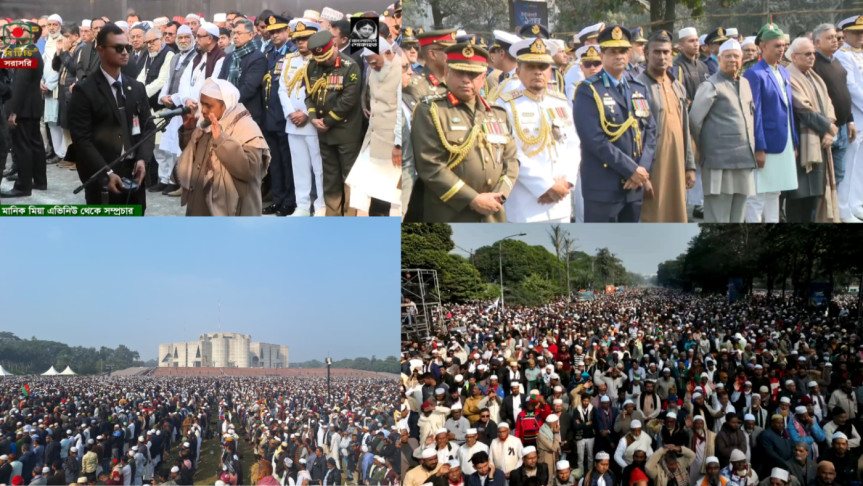
The janaza of Begum Khaleda Zia is scheduled to be held at 2:00 pm on Wednesday, after Zohr prayers, on the premises of the National Parliament House and Manik Mia Avenue.
The Khatib of Baitul Mukarram National Mosque will lead the prayer. She will be buried with full state honour beside her husband, former President Ziaur Rahman, at Zia Udyan in Sher-e-Bangla Nagar in the capital.
Khaleda Zia, three-time prime minister and the country’s first female prime minister, passed away at the age of 80 while undergoing treatment at Evercare Hospital in Dhaka early Tuesday morning.
Her elder son, BNP Acting Chairman Tarique Rahman, and other family members were by her side at the time of her death.
Following her death, the interim government declared three days of state mourning from Wednesday to Friday (Dec 31–Jan 2), with Wednesday observed as a public holiday.
Dhaka witnessed an unprecedented outpouring of grief on Wednesday as millions of mourners from across Bangladesh converged on Manik Mia Avenue to pay their final tributes to three-time Prime Minister and legendary political leader BNP Chairperson Begum Khaleda Zia.
From Tuesday night, all major roads leading to Manik Mia Avenue were crowded as people travelled from every hook and corner of the country by buses, trains, launches, and metro and other services. Scenes of deep sorrow were visible, with thousands of mourners seen weeping openly.
The influx of BNP leaders and supporters in the capital intensified following the spread of news of Begum Zia’s death. Continuous streams of people arrived from different regions of the country. Authorities struggled to manage the massive crowd as the capital became the focal point of national mourning.
Despite the severe cold, leaders, activists and ordinary citizens began gathering at Manik Mia Avenue and surrounding areas late Tuesday night. By early Wednesday morning, the Jatiya Sangsad Bhaban complex, nearby roads and pavements were filled to capacity. Many spent the night outdoors to secure a place near the funeral venue.
Leaders and activists from all over the country arrived in large numbers by road, rail and metro. BNP, Jubo Dal and Chhatra Dal leaders reported thousands of participants travelling in organized groups to attend the funeral.
Black flags were seen along roads and party offices, while BNP leaders and activists led processions from districts surrounding Dhaka. People from all walks of life, regardless of political affiliation, joined the mourners, creating a sea of grief-filled faces.
Mourners stood shoulder to shoulder holding national flags, party banners and portraits of Khaleda Zia. Volunteers guided crowds as density increased, while many were seen praying or silently wiping away tears.
Law enforcement agencies tightened security across the area. Medical teams, ambulances, water distribution points and temporary shade arrangements were deployed to manage the massive gathering.
Metro rail stations across Dhaka also saw overflowing crowds as people rushed to attend the janaza. Additional MRT Police were deployed at key stations, including Secretariat, Shahbagh, Farmgate and Bijoy Sarani. Passengers were searched, security heightened, and crowd control measures enforced, though temporary congestion occurred due to long queues at ticket counters and gates.
BNP Secretary General Mirza Fakhrul Islam Alamgir urged party leaders and supporters to maintain discipline, calling the farewell a moment of national mourning that must remain peaceful and dignified.
Khaleda Zia was elected as the prime minister for the first time through a popular vote in 1991 and played a crucial role in restoring parliamentary democracy. She introduced the parliamentary system and the caretaker government mechanism to ensure free and fair elections. She is survived by her elder son, Tarique Rahman, two daughters-in-law and three grandchildren. Her younger son, Arafat Rahman Koko, passed away earlier in Malaysia.


